
How Sounds Help Solve Crimes
Looking back at our early days.

Eighteen months on, it feels like a good moment to revisit one of the first long-form pieces written about Earshot. In September 2024, just over a year into our work, Hannah El-Hitami spent time with us in London for Science Notes, das Magazin für Wissen und Gesellschaft, as part of their issue on Klang und Krach — sound and noise. The piece that resulted, Wie Sounds helfen, Verbrechen aufzuklären (How Sounds Help Solve Crimes), is a careful introduction to what sonic investigation looks like in practice, and we’re publishing an English translation of it here for readers who didn’t come across the original.
El-Hitami’s article moves between three cases that, at the time, captured where our work was headed. The killing of Nahel Merzouk in Nanterre, which we worked on in collaboration with INDEX, and where a five-second audio clip held the answer to a question the footage couldn’t resolve, anchors the piece. The October 2023 strike in southern Lebanon that killed Reuters journalist Issam Abdallah sits alongside it, with the drone analysis we carried out for Amnesty International and Human Rights Watch. And a third thread, woven through the piece, captures the more informal side of our work: our investigation into the killing of Hind Rajab and her family in Gaza, whose findings we shared with the Washington Post in response to their questions, and an exchange with Liminal in Italy, walking them through our methodology for earwitness interviews so they could apply it in their own investigations.
Reading it back now, what stands out is how much of our approach was already in place: the insistence on probabilities rather than certainties, the commitment to transparent methodology, and the conviction that acoustic evidence deserves the same forensic seriousness as the visual. A lot has happened in the eighteen months since, but the foundations El-Hitami captured are still the ones we’re building on.
Optional paid support: If you’d like to support our work, monthly subscriptions are available at $5.00. Earshot is the foremost independent nonprofit organisation producing sonic investigations with and on behalf of communities affected by corporate, state, and environmental violence. Your support enables us to conduct investigations, develop the field, and establish sonic evidence within accountability frameworks.
The collection of evidence

Earshot uses acoustic evidence to solve crimes: the sound of a gunshot, the high-pitched humming of drones. The organisation aims to solve cases involving human rights violations where the state itself is the perpetrator.
One sunny morning in June 2023, Nahel Merzouk is shot dead. During rush hour in the Parisian suburb of Nanterre, a police officer points his gun at the 17-year-old who is travelling in a yellow Mercedes with two friends, and kills him at point-blank range.
Passers-by film the incident. One video shows two police officers leaning through the driver’s window. When Merzouk suddenly accelerates, a shot rings out. The car travels a little further, before crashing into an obstacle and coming to a halt. At quarter past nine, Merzouk is dead.
The fatal shooting of the French teenager of Moroccan-Algerian descent sparked fierce protests in France. Many saw it as a symptom of a racist system that treats young people from migrant backgrounds with excessive force. The United Nations has accused the French police of structural racism.1
It is beyond doubt that a police officer killed an unarmed minor. But the footage does not show why the officer fired. Was it self-defence, as the officer claimed afterwards? Or was it murder, an example of racist police violence? The answer may lie in a five-second audio recording of the exchange between the officer and the victim immediately prior to the incident.
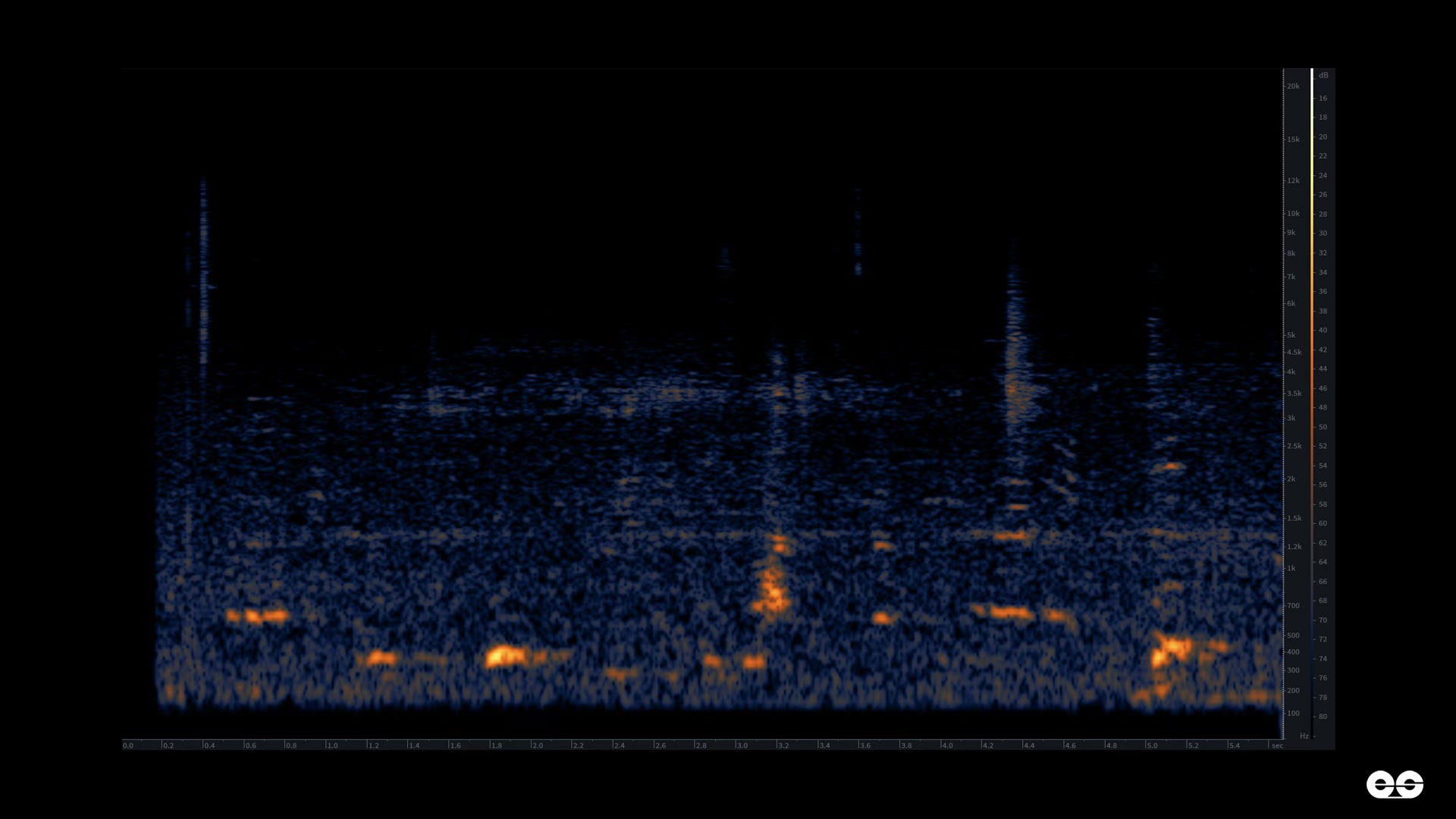
“The entire debate revolved around this section here, which remains incomprehensible”, says Lawrence Abu Hamdan, pointing to a few blurry orange spots on his laptop screen.
The spots resemble car headlights in the dark. These spots form part of a spectrogram, a visual representation of sound frequencies. Where the spots become denser, someone can be heard speaking. But who? And what? Due to the poor audio quality of the mobile phone videos, this was initially impossible to discern, says Abu Hamdan.
Lawrence Abu Hamdan, 39, describes himself as a “private ear”, a play on the English term “private eye” for a private detective. This is because, in his investigations, he pursues acoustic evidence. About a year ago, he founded the not-for-profit organisation Earshot. The killing of Nahel Merzouk was the first case for the three-person team. Abu Hamdan and his colleagues used special software to digitally enhance and analyse the crucial seconds of the recording. What they discovered could help solve the case.
In early April, the team meets in London. Abu Hamdan is wearing a brown-and-blue lumberjack shirt and thick-rimmed glasses. Visually, little may remain of the teenager who played in a punk band, but the passion for sound and the political awareness from that time remain with him to this day.
Some of Earshot’s work is based on the methods of forensic linguistics, a discipline that deals with language in the context of criminal investigations. Yet, while forensic linguists typically work with state law enforcement agencies, Earshot is dedicated to investigating human rights violations perpetrated by the state.
“In human rights work, acoustic evidence is still perceived as inferior to visual evidence”, says Abu Hamdan. There is simply no expertise available to analyse the acoustic material. Without Earshot this gap would remain. “There is no one else doing this work”.
For more than 15 years, the British-Lebanese researcher and artist has been engaged in acoustic research. He completed a PhD on the subject, has collaborated with organisations such as Amnesty International, and has published research in international media. He has also presented his findings in art exhibitions, for which he received the Turner Prize in 2019.
Abu Hamdan and his team usually work from an office in south-east London. As the power lines are currently being repaired there, Abu Hamdan is sitting in his sister’s flat today. Together with his colleague Fabio Claudio Cervi, he has set up in the living room at a large wooden table. They have set up their so-called ‘supercomputer’ and a microphone; on the table lie sound cards that can be connected to the PC, a pink sketchbook, headphones and memory cards, with the last square of a bar of chocolate in between. Cervi is currently working on a long-term project for Earshot: a video-game simulation about noise pollution. While he is programming, he and Abu Hamdan answer questions from a journalist from the Washington Post, on whose behalf they have carried out an acoustic analysis.
“French sometimes listened to a single syllable for three days” — Abu Hamdan
Abu Hamdan entered the world of audio investigations in 2009 following a meeting with forensic linguist Peter French, who had been involved in thousands of police investigations. In 1984, police interviews in the UK had to be recorded for the first time. Suddenly, courtrooms were debating exactly what a defendant had meant, rather than simply accepting the written police record. “French would sometimes listen to a single syllable for three days,” says Abu Hamdan. “His attention to linguistic detail was groundbreaking.”
French investigated, for example, whether defendants had said different things in court than in police interviews, or whether their strong dialects had caused misunderstandings. Later, he and his colleagues were tasked with investigating beyond literal statements. They listened to background noise on emergency calls, for instance, to gather information about the crime scene. “In this way, the linguists broadened their auditory horizons, analysing not only human voices, but also the voices of bodies, architecture, ammunition and infrastructure,” wrote Abu Hamdan in his doctoral thesis.
Earshot’s work also goes beyond the analysis of language. Among other things, the team has developed a tool for analysing gunshots recorded by mobile phone cameras, for example. The “Supersonic Compass” analyses two things: the shockwave of a projectile flying through the air, and the explosion at the muzzle of the rifle when the trigger is pulled.
“Our tool simulates the movement of the projectile and, using the position of the recording camera, reveals the shooter’s location,” explains Cervi.
This allows the statements of eyewitnesses and earwitnesses to be corroborated. Furthermore, Abu Hamdan, Cervi and their colleague Caline Matar regularly verify the authenticity of audio recordings. To do this, they listen, for example, for electromagnetic interference that can be heard in the background of recordings.
“We work with the excess: we listen to the noises that the brain normally filters out.”
In a corruption case, Earshot was able to establish that leaked recordings of government officials were authentic.
“The background noise remained consistent throughout the entire recording,” explains Abu Hamdan. No section had been removed or added afterwards.
A notification pops up on Cervi’s screen: the Italian organisation Liminal is calling because they want to find out what drones and other aircraft migrants encountered while crossing the Mediterranean. Abu Hamdan explains how to properly interview earwitnesses: don’t assume too much, but let them recall things themselves. Offer various sounds for comparison.
Analysing drone sounds is part of everyday life at Earshot. In war zones such as Ukraine or Gaza, the high-pitched hum of drone engines is omnipresent. At the end of 2023, Earshot analysed the sounds of an Israeli drone in collaboration with Amnesty International and Human Rights Watch. The drone could be heard in a video recording made by journalists who were struck by an Israeli tank shell in southern Lebanon. Reuters reporter Issam Abdallah was killed, and six other journalists were injured.
Earshot works with sounds that are otherwise barely noticed: background noise or the humming of drones, for example. But the direction from which sounds come can also provide clues – for example, to the origin of artillery shells. In this video, the Earshot team explains how, using sound recordings from running cameras, they were able to determine that an attack on journalists in southern Lebanon in 2023 originated from Israel.
The cameras of the journalists under attack also recorded minutes of drone whirring prior to the explosion. By analysing the rise and fall of the sound, Earshot can reconstruct the drone’s movement. The team thus established that, in the 23 minutes before the attack, the Israeli drone circled the journalists’ position from the air eleven times. Israel must therefore have known that the people on the ground were members of the press.
Abu Hamdan plays the drone noise on his PC: a piercing whirring, a harbinger of death and the acoustic epitome of automated warfare.
“The waveform of the frequency tells us something about the movement of this drone,” explains Abu Hamdan.
The sound gets lower as the drone moves away. It becomes higher-pitched and louder as it approaches. Because the engine is located at the rear, the drone is loudest at the moment it turns away and flies off. “Based on the volume and frequency, we realised that the drone had been circling above the journalists for 23 minutes before the attack.” During this time, the attackers were able to gather enough information to determine that their targets were not military, but rather the press.
The cases that Earshot takes on could be pursued more easily by the relevant states. Law enforcement agencies would have the opportunity to access, for example, the video recorded by the drone’s camera or the bodycams of police officers who killed or injured people. Earshot’s work, however, begins where the state drops, manipulates or drags out investigations — or where there is concern that this might happen.
Abu Hamdan plays the drone noise on his PC: a piercing whine/whirring, a harbinger of death and the acoustic epitome of automated warfare.
As in the case of Nahel Merzouk, whom a police officer in Paris killed with a bullet to the chest. Although the investigation into the officer is still ongoing, he has been at large since November 2023. Statistics show that cases against police officers are dropped far more often than those against other suspects. It is cases like these that Abu Hamdan and his colleagues listen to closely.
“Even if our evidence doesn’t make it to the courtroom, we can at least exert pressure by standing up for the results of our investigations and bringing them to the public’s attention.”
Once the Earshot team had processed the audio track from the videos of the incident, it became clear what was said before the shot was fired: “Coupe”, the French command to switch off the engine. And “Pousse-toi”, colloquial for: “Move out of the way”. The context and slang might suggest that the teenager Merzouk shouted “Move out of the way!” before stepping on the accelerator to flee, which posed a danger from the police officer’s perspective. This was initially claimed by the French media as well.
Earshot, however, discovered that the two statements must have come from the same voice. A second mobile phone video from the scene of the incident shows that it was the police officer who said “Coupe”. The fact that the frequencies of both statements match makes it clear that he also said “Pousse-toi”.
“If the voice came from inside the car, was reflected off the wall and then picked up by the mobile phone’s microphone, it would look completely different on the spectrum from the voice outside the car.”
Earshot has processed the audio track of one of the mobile phone videos showing the police officer interacting with Nahel Merzouk. This allows the team to analyse exactly what was said – and by whom. It becomes clear that it was the police officer who shouted “Pousse-toi!”, colloquial for “Move out of the way!”. This led Earshot to a theory: what if the police officer was instructing his colleague to step aside — because he intended to shoot?
Earshot does not claim that its analyses are exhaustive or represent absolute truth. “We only ever talk about probabilities,” says Abu Hamdan. “And we make it transparent how we arrive at our conclusions.” An investigation like the one into Merzouk cannot solve a case, but it can raise crucial questions.
For example: Why did the police officer say “Get out of the way” to a young man whom he had just ordered to switch off the engine, whilst pointing a gun at him? Abu Hamdan has a theory: “If the police officer directed the command not at Merzouk but at his colleague — ‘Get out of the way, because I’m about to shoot’ — then Nahel understood at that moment what was going to happen and drove off to save his life.”
Merzouk is said to have told his passenger: “He’s crazy, he shot at me.” Then he died.
📄 Full investigation: For complete technical analysis and sound propagation modeling, read our assessment here: Police Brutality in Nanterre, Paris
In its statement of 7 July 2023, the UN Committee on the Elimination of Racial Discrimination (CERD) called on France to “address, as a matter of priority, the structural and systemic causes of racial discrimination, including in law enforcement, in particular in the police.” See: https://www.ohchr.org/en/press-releases/2023/07/statement-france-un-committee-elimination-racial-discrimination
Optional paid support: If you'd like to support our work, monthly subscriptions are available at $5.00. Earshot is the foremost independent nonprofit organization producing sonic investigations with and on behalf of communities affected by corporate, state, and environmental violence. Your support enables us to conduct investigations, develop the field, and establish sonic evidence within accountability frameworks.